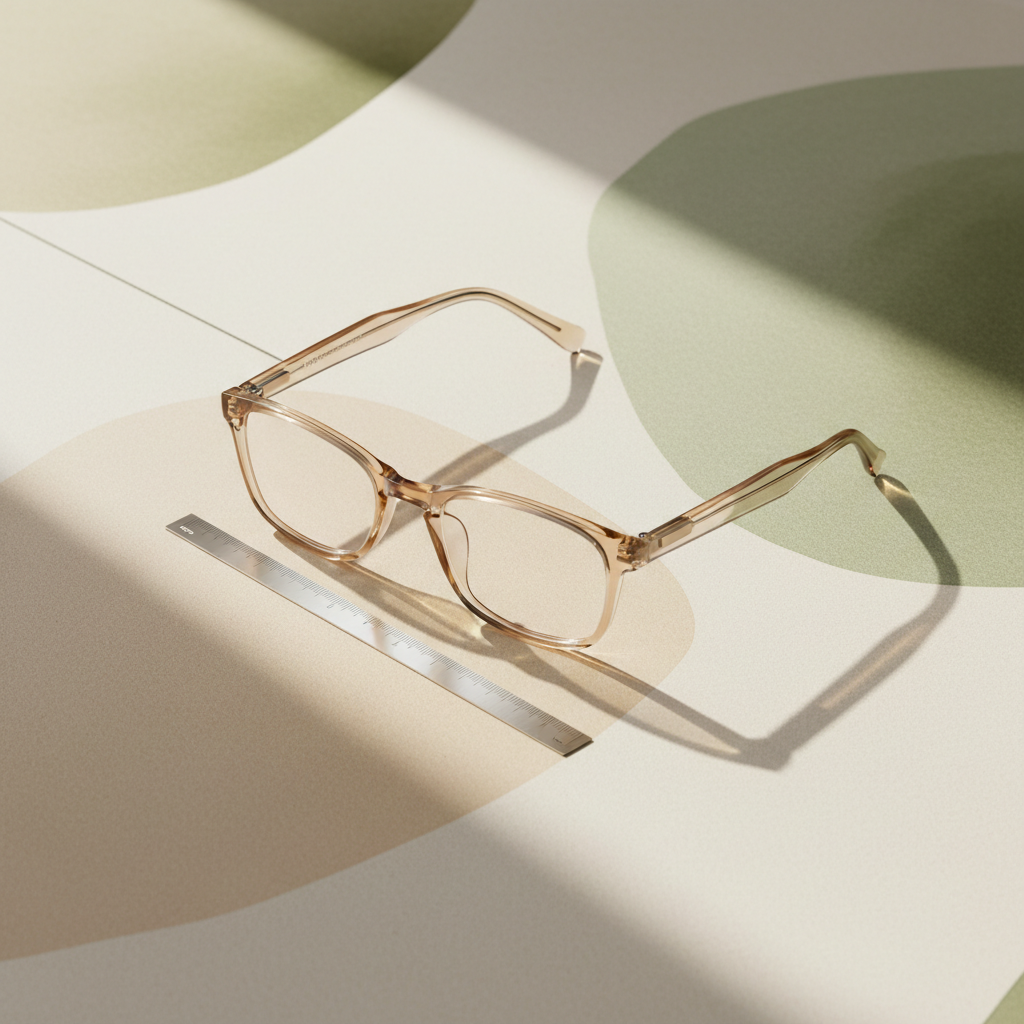
The small numbers printed inside a glasses temple, usually in a form like 52-18-145 or 52□18 145, are the lens width, the bridge width and the temple length, all in millimetres. Read them off a pair that already fits you well, compare them to the frame you are considering, and you have the most reliable sizing information available when buying glasses online. The numbers do not tell the whole story, but they remove most of the guesswork.
Where to find the measurements
Take off your current glasses and look at the inside of the temple arms, the parts that run back over your ears. On most frames one arm carries the model name and colour code, and the other carries the size. Occasionally the size is printed on the inside of the bridge instead.
On very old or heavily worn frames the print may have rubbed off. A ruler gets you close enough, provided you measure the same things the print would have told you. Take the 52-18-145 example: lay the frame face down and measure one lens across its widest point, not along its top edge; that is the 52. Measure the gap between the two lenses at their closest point, where the frame rests on your nose; that is the 18. Then measure one arm from the hinge screw to the tip; that is the 145. Round to the nearest millimetre and you have numbers you can compare directly with a product page.
The three numbers almost always appear in the same order:
- Lens width (also called eye size): the horizontal width of one lens at its widest point, typically between 40 and 62 mm.
- Bridge width: the shortest distance between the two lenses, where the frame sits on your nose, typically between 14 and 24 mm.
- Temple length: the length of the arm from the hinge to the tip, typically 135 to 150 mm. Most frames come in a small set of standard lengths such as 135, 140, 145 and 150.
Some frames print a fourth number, the lens height, which matters if you wear progressive or bifocal lenses because the lens needs enough vertical room for the different zones. The square symbol between the first two numbers refers to the "boxing system", a standard way of measuring lenses as if each sat inside a rectangular box. You do not need to know the details of that system to use the numbers; just know that two frames measured this way can be compared directly.
What each number does for fit
Lens width
Lens width is the number people notice first, and the one most often misunderstood. It describes one lens, not the whole frame. A 52 mm lens on a thin wire frame and a 52 mm lens on a chunky acetate frame produce very different overall widths, because the rims and bridge add to the total. Lens width is useful mainly as a proportion: a wide lens on a narrow face pushes the lenses outward from your eyes, and a narrow lens on a wide face makes the frame look pinched.
Bridge width
The bridge is the number most worth getting right, because it decides where the frame sits. A bridge that is too narrow perches high and pinches; a bridge that is too wide slides down your nose and lets the lenses sit too low. Faces vary a lot here, which is why many brands now offer the same model with two bridge sizes or with adjustable nose pads. If you have a pair that sits comfortably, treat its bridge width as a target and try to stay within a couple of millimetres of it.
Bridge width also interacts with lens width. If your pupils sit close together, a narrow bridge keeps the optical centres of the lenses near your eyes. If they sit far apart, a wider bridge does the same job. This is one reason an optician asks about pupillary distance, and why a frame that looks great on a friend may not sit the same way on you.
Temple length
Temple length is the most forgiving of the three, and the standard sizes explain why. Lengths come in 5 mm steps, 135, 140, 145 and 150, and one step either way is usually absorbed by the curve behind the ear, which an optician bends to fit as a matter of routine. If your current pair is a 145 and the frame you want only comes in 140 or 150, either will almost certainly be adjustable. It becomes important at two steps or more: a 135 arm on a head that normally wears 145 will pull the frame forward and dig in behind the ears, and a 150 arm on a head that wears 140 will leave the frame loose and wobbling when you look down. If you are between two options, the longer one is usually easier to adjust, because an optician can tighten a curve more readily than lengthen an arm.
The number product pages often leave out: total front width
The measurement that best predicts whether a frame will look right on you is the total front width, the distance from the outer edge of one rim to the outer edge of the other. It is not one of the three printed numbers, so you may need to estimate it:
`` front width ≈ (2 × lens width) + bridge width + (2 × rim thickness) ``
For a 52-18 frame with 3 mm rims, that comes to about 128 mm. Good product pages state the front width directly, and it is worth favouring shops that do. Compare it with a frame you own that looks balanced on your face: if the new frame is more than a few millimetres wider or narrower, expect it to read differently, even if the lens and bridge numbers look similar.
A practical method for buying online
- Write down the numbers from your best-fitting pair. If you own several, pick the one that sits comfortably without sliding and whose width looks balanced in photos of you.
- Decide which number is non-negotiable. For most people that is the bridge. Keep it within about 2 mm.
- Check front width before lens width. Lens width alone can mislead; front width tells you how the frame will sit against your temples.
- Treat temple length as adjustable unless the difference is 10 mm or more.
- Look at the shape and weight separately. Two frames with identical numbers can feel completely different if one is thick acetate and the other thin metal. Measurements tell you where a frame sits; they say nothing about how heavy it feels after three hours.
What a virtual mirror adds, and what it does not
Numbers tell you whether a frame will physically fit. They are much worse at telling you whether it suits you, which is the question that actually decides a purchase. This is where a virtual try-on can help, provided it respects the measurements rather than hiding them.
Many camera filters stretch a frame to match the detected face, so every frame appears to fit perfectly. That looks pleasing and tells you nothing: a 48 mm frame and a 58 mm frame end up the same size on screen. When we built Reflektit's live mirror, we took the opposite approach. Each 3D frame is rendered at its declared millimetre width, and the shopper calibrates the mirror once by holding up a standard bank card, whose dimensions are fixed by an international standard at 85.60 × 53.98 mm. Once the mirror knows your true scale, a narrow frame looks narrow on you and a wide one looks wide, which is exactly the information the printed numbers are trying to give you, shown on your own face instead of on a spec sheet.
Even so, a mirror cannot tell you everything:
- It cannot tell you how a frame weighs on your nose after an afternoon.
- It cannot replace an optician's adjustment of the nose pads and temple curve.
- It cannot measure your prescription or guarantee lens thickness, which depends on your prescription and lens material.
Used together, the numbers plus a true-size mirror cover most of what you would learn in a shop, short of picking the frame up. If you also want to check how a camera-based feature handles your data before you use one, we explain ours plainly on the privacy page: the camera video and face tracking stay in your browser and are never uploaded.
Quick reference
| Number | Typical range | How strict to be | |---|---|---| | Lens width | 40 to 62 mm | Compare as a proportion; check front width too | | Bridge width | 14 to 24 mm | Stay within about 2 mm of a pair that fits | | Temple length | 135 to 150 mm | Flexible; 5 mm either way is usually adjustable | | Lens height | 25 to 45 mm | Matters most for progressive lenses | | Front width | Varies by frame | Within a few mm of a pair that looks balanced |
Keep your best-fitting pair's numbers in your phone notes, favour shops that publish front width, and when the numbers look right but you are still unsure how a frame will look, try it on yourself at true size before you order.