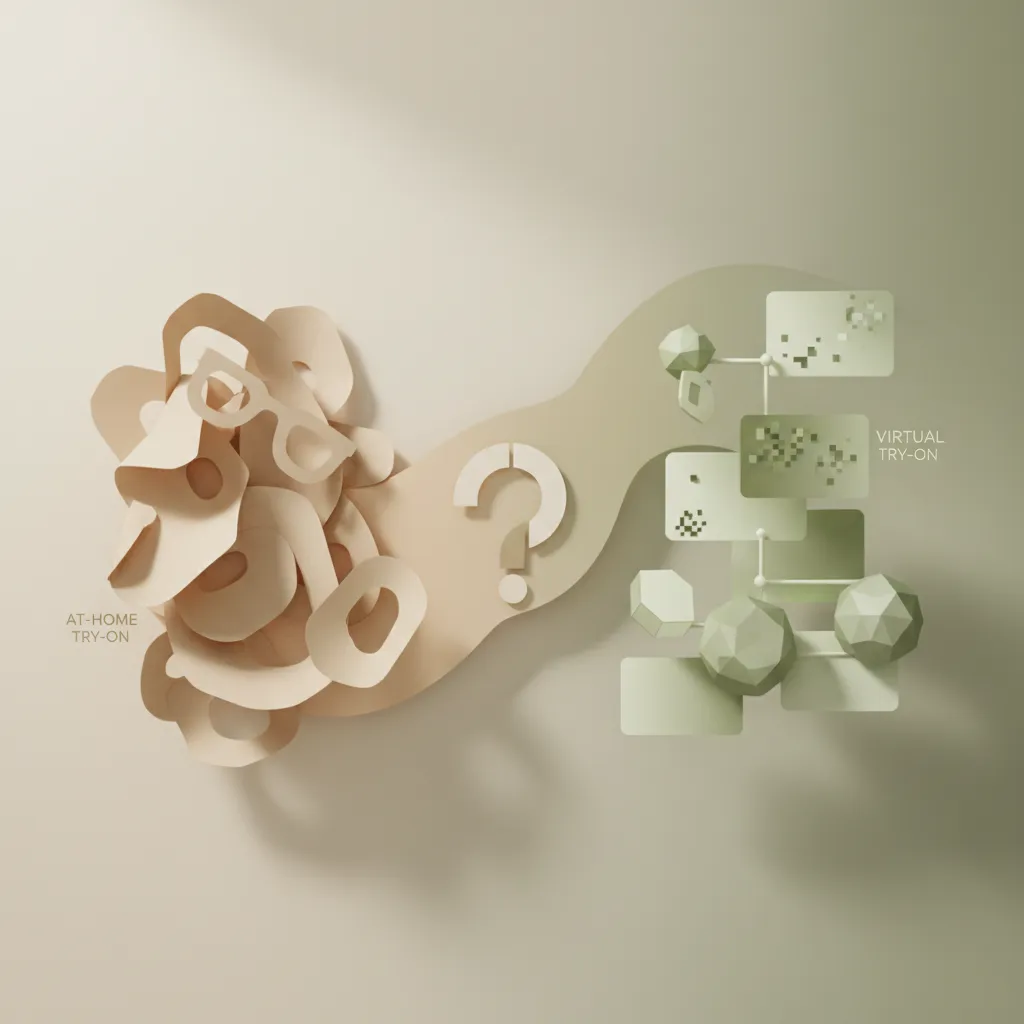
A virtual try-on can reliably show you how a frame's shape, colour and proportions look on your face, and a true-to-scale one can show whether the width is roughly right. It cannot tell you how the frame feels on your nose, whether the temples will pinch behind your ears, or how thick your lenses will turn out. Treat it as a very good mirror, not as a fitting appointment, and use it alongside the frame measurements.
Why this question matters more right now
Gift season is also returns season, and glasses are a category where a return is almost never about a defect. Nobody sends back a frame because it broke in the box. They send it back for one of two reasons. The first is look: the frame sat differently on their face than on the model in the product photo, or the tortoiseshell that read warm in the studio turned muddy against their hair. The second is fit: a 58 mm front on a face that wears 48 mm, a bridge that slid down the nose by day two, a temple tip that left a red mark behind the ear by lunchtime.
A virtual try-on exists to remove the first reason. It can do very little about the second, and a filter-style tool that stretches every frame to your face actively hides it, because the 48 and the 58 look the same. Knowing where that line sits saves you a parcel trip, and saves the shop the cost of handling it.
What a good virtual try-on can tell you
Whether the shape suits your face
This is the thing a try-on does best. Seeing a round frame against your jawline, or a wide rectangular frame against a narrow face, answers a question that product photos on a model never can. You get to judge proportion with your own eyes, in your own light, turning your head as you naturally would.
How the colour and finish read on you
Tortoiseshell that looks warm on a studio photo can look muddy next to certain skin tones and hair colours. A gunmetal frame can disappear or stand out depending on your complexion. Because a live try-on uses your webcam feed, you see the frame under the light you actually live in, not under studio lamps.
How the frame sits as you move
Static photos show one angle. A live try-on that tracks your head shows you the frame in profile, from slightly above, and while you talk. This is where you notice whether a chunky acetate frame hides your eyebrows or whether a thin metal frame vanishes from the side. It is also where filter-style tools give themselves away, because the glasses float or swim as you turn.
Whether the size is roughly right, if the tool renders true to scale
This is the big one, and it only works if the tool is honest about size. Many try-ons stretch every frame to match your detected face width. That is the Snapchat filter approach, and it means a 48 mm frame and a 58 mm frame look identical on you. The one question that decides whether glasses fit is exactly the question they hide.
Reflektit takes the opposite approach. Each 3D frame is rendered at its declared millimetre width, so a 48 mm frame looks 48 mm on you and a 58 mm frame looks visibly wider. To know your true scale, the mirror asks for a one-time calibration with a standard bank card. Every card that follows the ISO/IEC 7810 ID-1 format measures 85.60 by 53.98 mm, which makes it a reference object almost everyone already has in their pocket. Once the mirror knows how big a card is on your camera, it knows how big your face is, and the frames stop lying.
If a tool does not ask you for any reference object and does not mention real size anywhere, assume it is scaling the frame to fit.
What a virtual try-on cannot tell you
Pressure points and comfort
No camera can measure how a nose pad presses on the side of your nose or how a temple tip sits behind your ear. These depend on the frame's weight, the bridge design, the curve of the temples and the thickness of your lenses. A try-on can show you that the bridge looks right. It cannot show you that it will leave red marks by lunchtime.
Lens thickness for your prescription
A try-on renders demonstration lenses, usually thin, clear, and sometimes with a little realistic refraction. Your real lenses depend on your prescription, the lens material and the frame size. A strong prescription in a large frame produces thick edges that a try-on will not predict. If your prescription is strong, ask the optician about lens index before you fall in love with a big frame.
Exact nose fit
Bridge width is a number, but nose shape is not. Two people with the same bridge measurement can need very different frames because of how high or low their nose sits relative to their eyes. A try-on shows the frame resting in a plausible position. Whether it rests there in real life is something only the physical frame can confirm.
Whether you will still like it in a month
This one is not a technology limit, it is a human one. A try-on makes a fast first impression easy, which is exactly when people choose something bold and regret it. A chunky acetate frame that hides your eyebrows looks striking for thirty seconds in the mirror and tiring in every photo for the next two years. Take a screenshot in the try-on, come back the next day in different light, and look again. If you still like it, you probably will in a month too.
A quick way to tell a mirror from a filter
Before you trust any try-on, check these signs:
- Does it mention real size or a calibration step? If not, it is probably stretching frames to your face.
- Do two frames of very different widths actually look different on you? Pick the narrowest and widest in the range and compare.
- Do the temples disappear behind your head when you turn? If the arms draw over your cheek at 45 degrees, the tool is drawing a flat sticker, not a 3D object sitting on a head.
- Does it tell you where your camera feed goes? A trustworthy tool says plainly whether the video stays in your browser.
A practical buying routine
Use the try-on for what it is good at, then confirm the rest with numbers.
- Find a pair you already own that fits well. Read the three numbers printed inside the temple. Our guide on how to read the numbers on your glasses frame explains what lens width, bridge and temple length mean.
- Shortlist by look in the try-on. Shape, colour, proportion. Be ruthless here, it is what the tool is for.
- Filter the shortlist by measurements. Stay within a couple of millimetres of your known-good bridge width. Lens width can vary more if the overall front width is similar.
- Read the returns policy before you pay. Shops vary widely on whether frames with prescription lenses fitted can be returned, and on who pays postage.
- Sleep on it. Especially if the frame is a departure from what you usually wear.
If you are shopping for someone else as a gift, step 1 is the one that matters. Borrow their current glasses for thirty seconds and photograph the inside of the temple. A try-on on your own face tells you nothing about theirs, but their frame measurements tell you almost everything you need to pick a size.
A note on privacy
A camera try-on means pointing a webcam at your face, so it is fair to ask where that video goes. The honest answer varies by tool. Reflektit's live mirror runs entirely in the browser: the camera feed, the face tracking and the measurements from the card calibration never leave your device. The only time a photo is sent anywhere is the separate clothing preview, which uses a photo you choose to upload, and tells you so before you do. If a tool cannot give you that kind of plain answer, that is a reason to use a different one.
The short version
A virtual try-on answers "will this look right on me" very well, answers "is this the right size" only if it renders frames at true scale, and does not answer "will this be comfortable" at all. Use it to shortlist by look, confirm with the measurements inside a frame you already own, and read the returns policy. If you want to see how different a 48 mm and a 58 mm frame actually look at real size, try it on yourself.